

Prosthetics for Seniors: Mobility Has No Age Limit

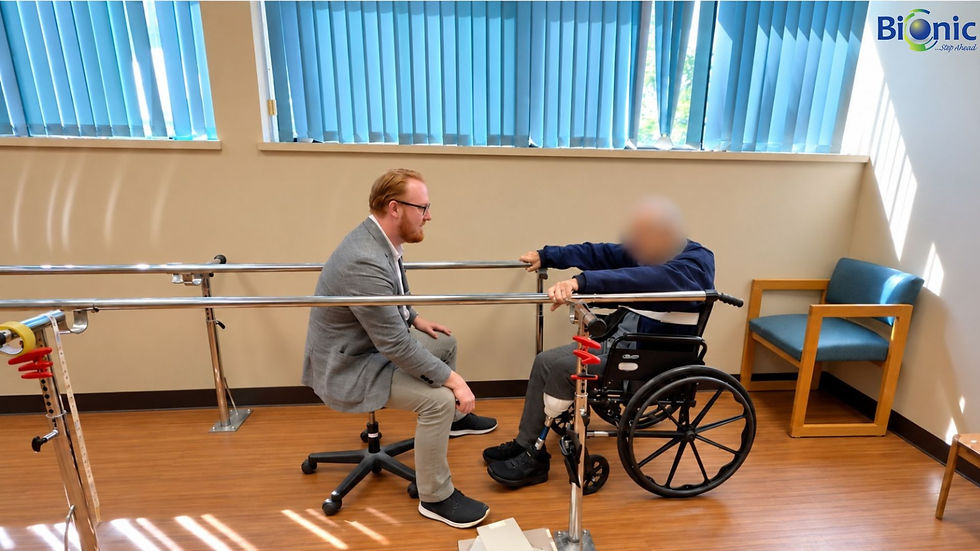
At 90 years young, our client has shown that nothing is impossible in prosthetic care. By standing up from his wheelchair and walking with minimal help from his clinician, this patient has demonstrated that anything really is possible if you put your mind to it and truly apply yourself.
What 90 Years Young Looks Like In Our Clinic
In a bright therapy room with a set of parallel bars, our client starts in his wheelchair. Wearing a gait belt around his waist, his clinician sits next to him on a rolling stool. This allows the clinician to be close enough to help and far enough to let him lead.
After standing, he grips the bars, finds his balance, and starts to walk. The patient displays focus, patience, and determination, and we are proud of him and to be a part of his story. He reminds us that mobility and independence have no age limit.

Patient practicing walking with a prosthetic leg using parallel bars.

Patient undergoing prosthetic gait training with a prosthetist
Is Age a Barrier to Walking with Prosthetic Legs?
As demonstrated by our patient, it is clear that age on its own does not affect the ability to walk with a prosthetic leg. However, when we plan care for an older adult, we must consider overall health, strength, balance, how well the residual limb is healing, and the patient’s goal. Every path is different, some patients move quickly through training while others need more time and adjustments. Both situations are common and no matter the amount of time, prosthetic care helps to work towards creating confidence and independence.
What This Can Mean for Families
If someone you love is facing an amputation, or is living with limb loss and wondering what comes next, here are the steps that are available:
Ask what is possible. Do not assume the answer is no because of age.
Set goals that fit daily life, such as standing or walking short distances.
Show up for fittings and training sessions. Consistency is key.
Choose a care team you trust and don’t hesitate to ask any and every question you have.
If you or a loved one wants to talk about walking with a prosthetic leg, find a Bionic Prosthetics & Orthotics clinic near you and start the conversation.
Frequently Asked Questions
Can Older Adults Walk With a Prosthetic Leg?
Many can, with the right device and training. Walking on a prosthetic leg takes strength and balance. Training is gradual and goals are set to match the person. Our team helps you choose a realistic first goal, such as standing or short walks.
What is Gait Training With Parallel Bars?
Gait training is the part of prosthetic care where you learn to walk with your device. The gait belt is a simple safety tool. It lets your clinician steady you without taking over. As you get stronger and more confident, the support gets lighter. The parallel bars give you something solid to hold while you practice. Most sessions work on a few basics such as standing up safely from a chair or wheelchair, shifting weight evenly from one leg to the other, taking steady and controlled steps, and turning and sitting down without losing balance.
What is a Gait Belt Used For?
A gait belt is a strap worn around the waist during training. It gives your clinician a safe place to hold and steady you if you lose balance, without taking over the movement.
How Long Does it Take to Learn to Walk with a Prosthetic Leg?
Learning to walk with a prosthetic leg varies from person to person. Timing depends on your health, strength, the type of device, and how often you practice. Your clinician can give you a realistic timeline for your goals based on your ability and personal goals.
How Can I Help a Parent or Grandparent After a Leg Amputation?
Ask their care team what goals are realistic, go with them to fittings and training sessions when you can, and encourage steady practice. Small wins matter as much as big ones. If they feel discouraged, offer support and tell the clinician so the plan can be realistically adjusted.
How do I find a prosthetist near me?
Bionic Prosthetics & Orthotics has clinics across the United States. States include: Florida, Illinois, Indiana, Kentucky, Michigan, New Jersey, North Carolina, Ohio, Pennsylvania, Tennessee, Texas, and Wisconsin. Use our clinic locator to find the one closest to you, then call to book a consultation..


Comments